The industry's go-to answer has been 'right-sizing': building a custom box for every order from fanfold corrugate. It works, but it shifts your packaging into a specialty material stream and a long-term equipment-plus-consumables commitment. Downsizing gets most of the same result from the box suite you already have: select the closest footprint, then cut the height down to what's actually inside. It's also one of those initiatives that looks simple on a spreadsheet and gets complicated fast on the actual packaging line.
WHY IT MATTERS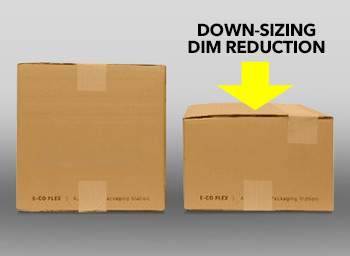
The Real Cost of Shipping Empty Space
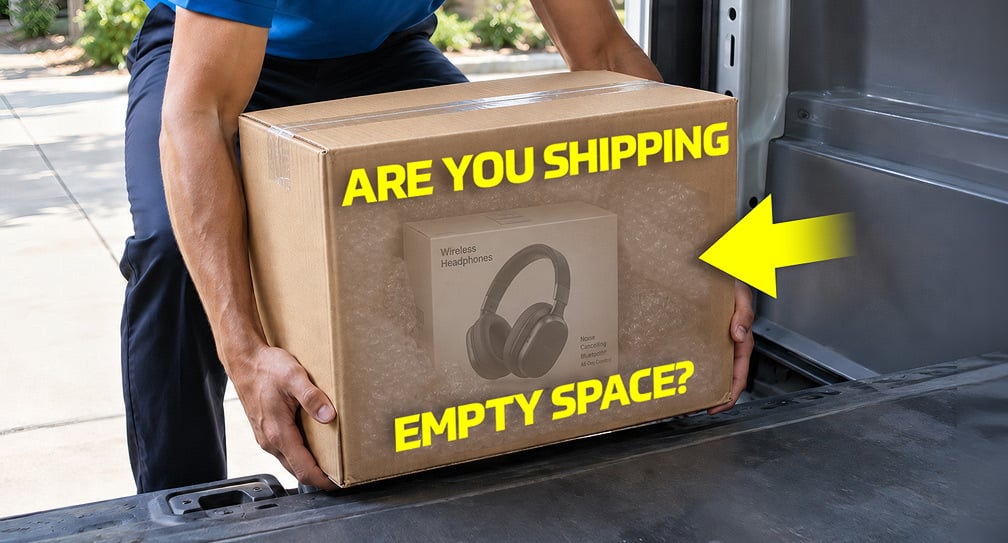
Carriers calculate dimensional weight by multiplying a package's length, width, and height and dividing by a standard factor, then billing whichever is greater, that calculated figure or the actual weight. A small, lightweight product in an oversized box can end up billed as if it weighed several times more than it does.
That gap compounds fast. Oversized boxes need more void fill to keep the product from shifting, take up more space on a truck or a pallet, and use more corrugate per shipment than the product actually requires. None of that adds any protection a right-sized version wouldn't also provide.
|
Why It Adds Up |
THE CHALLENGE
Why downsizing Is Harder Than It Sounds
The obstacle isn't usually convincing anyone that downsizing saves money. It's operational. Every additional box size in the mix means another SKU to purchase, store, and keep stocked at the pack-out station, and warehouse space for box inventory isn't free either. Push too far toward a perfectly custom-fit box for every product and the packaging line slows down sorting through options. Stay with one or two standard sizes and most shipments go out with wasted space anyway. Downsizing changes that math: when one footprint can be cut to several heights, you get more fits from fewer box SKUs.
The practical answer sits in the middle: a manageable range of standard sizes chosen to fit the actual spread of the product catalog, rather than either extreme. Downsizing is what makes that middle ground work. Pre-scored heights let a single footprint cover two or three effective box sizes, so a small suite covers far more of the catalog.
|
Were It Breaks Down |
THE APPROACH
Three Ways to Cut Empty Space
Most downsizing programs land on one of three approaches, or some combination of the three, depending on order volume and how much the product catalog varies.
|
Tiered Standard Sizing Audit SKU dimensions and consolidate packaging into a small, deliberate range of box sizes, typically five to eight, chosen to minimize leftover space across the full product catalog. |
|
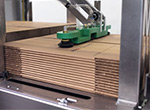
Box-on-Demand Equipment that creates a box cut and scored to the exact dimensions of each order at the point of pack-out. Equipment cuts and folds a custom box from continuous fanfold corrugate for every order. It's the most exact fit. Evaluate the full system: specialty material supply, contract terms, service staffing and software fees, along with the machine price. |
|
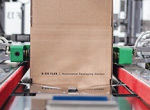
E-Co Flex Standard RSC boxes are selected automatically from the existing suite. Once the order is packed, sensors measure the fill height and the box is cut to the nearest pre-score, then sealed with water-activated or pressure-sensitive tape. Boxes still come from any corrugate supplier, and if the line is ever down, the same boxes can be packed by hand. |

DON'T STOP AT THE BOX
Protective Packaging Should Scale Down Too
A box only delivers its full benefit if the materials inside scale down with it. A smaller box still packed with the same volume of void fill used for the larger version cancels out a meaningful part of the material savings, and it can leave the product under-protected if the fill no longer matches the void space correctly.
Void fill and protective packaging systems that adjust output based on the actual empty space, rather than dispensing a fixed amount regardless of box size, close that gap and keep protection consistent across every box size in a tiered program.Downsizing attacks the problem from the other direction: when the box height is cut to the contents, there's far less void left to fi ll in the fi rst place.
HEAD TO HEAD
Comparing Approaches
|
APPROACH |
IMPLEMENTATION EFFORT |
WASTE REDUCTION |
BEST FIT |
|
One standard box size |
None, no change to current process |
Lowest, most shipments carry unused space |
Very low volume or highly uniform product lines |
| Tiered standard sizing | Moderate, one-time audit and box reorder | Significant, matches most SKUs to a close-fitting size | Most small to mid-size operations with a defined product catalog |
| Box on-demand forming | Low cost of entry via supply agreements, but limited to a specific sheet material from a limited supplier base | Highest, custom fit on every order | High-volume operations able to commit to a single sheet supplier under a supply agreement and provide product to box cubing data |
| Premade, pre-scored RSCs |
Low, readily available boxes with no equipment or material lock-in | High, scores to a close-fitting size at pack-out | Operations prioritizing cost control and supplier flexibility over a fully custom fit |
BOTTOM LINE
Small Changes in Box Size Add Up Fast
Downsizing doesn't require a single dramatic overhaul to pay off. Even moving from two box sizes to five or six, matched deliberately to the product catalog, measurably cuts void fill use, freight cost, and the dimensional weight charges that come with shipping air. The best result isn't always the most precise box. It's the lowest total cost over the life of the system. Downsizing gets you most of the fit, keeps your supply chain open, and gets more effi cient as your case suite tightens.
The bigger the operation, the faster those savings compound, but the underlying math works at any scale.
|
Ready to Find Out Where Your Packaging Is Oversized? IPG's Packaging Diagnostics program audits your current box mix and packaging line to identify downsizing opportunities specific to your product catalog and order volume. SCHEDULE A PACKAGING CHECKUP → LEARN ABOUT PACKAGING DIAGNOSTICS → |